The Difference Between Wheel Offset and Backspacing
The Wheel Deal
The Difference Between Wheel Offset and Backspacing
As professional tire and wheel installers, one of the most popular questions
that we deal with on a daily basis is, “What wheels and tires can I fit on my
vehicle?” Obviously, this varies on a case-by-case basis, but there are some
things that are common between any car or truck out there. Wheels have certain
characteristics that classify them; things such as diameter, width, load rating,
and even color can tell you everything you want to know about a wheel. However,
two of the most important things to consider when picking out custom wheels for
your ride is backspacing and wheel offset.
Many people believe that offset and backspacing are the same. While they are
related, they each have their own characteristics and can both affect the
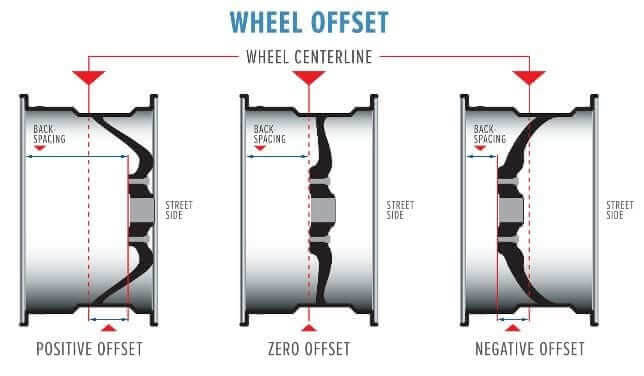
outcome of the stance of your ride differently. Offset is the amount (usually
measured in millimeters) of distance that the mounting surface of the wheel is
away from the centerline of the wheel.
Offset can be positive or negative- positive offset is forward (towards the
outer face of the wheel) and negative offset is backwards (towards the inner
face of the wheel). To visualize this, imagine a bicycle wheel; positive offset
would be akin to the hub of the wheel being pushed towards the outer rim, while
negative offset would be like the hub shifting towards the bike's frame.
Backspacing is the cousin of offset. Backspacing is the amount (usually measured
in inches) of distance that the mounting surface of the wheel is away from the
inner edge of the wheel. Think of it as how far the mounting surface of the
wheel extends towards the back of the wheel's hub.
Now, let's discuss a real-life example to better understand these concepts.
Let's say we have a 2011 Ford F-250. The stock 18x8 inch wheels have a 6.07 inch
backspacing. This wheel backspacing is good for a stock-sized tire, and keeps
the wheel and tire combination inside the fender. However, an 18x9 Fuel Hostage
wheel could have a 5.75 inch backspacing, a 5 inch, or a 4.5 inch backspacing.
Depending on the amount of lift, tire size, and other specific vehicle options,
all of these wheels could work on that vehicle.
Offset and backspacing can either make or break the look of your vehicle, but
they have a much more important role than that. They allow the suspension and
tires to work in concert with each other, affecting everything from suspension
clearance to fender rubbing, wheel travel, and turning radius.
Many lift kit manufacturers today have very specific offset and backspacing
specifications. They have determined the optimal wheel and tire fitment for your
vehicle- most of the time, it is best to stick to their guidelines. All in all,
it is best to determine the style of wheel you want, and having the experts at
OK 4 Wheel Drive pick out the best combination of offset and backspacing for
your application!
To clarify some common questions, we have a few FAQs:
Q: What is the difference between positive and negative offset?
A: Positive offset is when the mounting surface of the wheel is towards the
outer face of the wheel. Negative offset is when it's towards the inner face of
the wheel.
Q: Can I fit any size of wheel on my vehicle?
A: This varies depending on several factors including the vehicle's suspension,
wheel well size, and the vehicle's handling characteristics. Our team at OK4WD
can help determine the best fitment for your vehicle.
Ready to transform your vehicle's stance? Let our experienced team at OK4WD help
you select the best wheels and tires for your ride.